
The Trigonometric functions evaluate trigonometric and hyperbolic values.
This function accepts one argument X as input and returns the sine of X.
Syntax:
| process eval("identifier=sin(X)")
Example:
| process eval("sin_value=sin(length)") | fields length, sin_value
The above example returns the sine of the length field in the sin_value identifier.
The fields command displays the value of length and sin_value in a tabular form.

Sin function
This function accepts one argument X as input and returns the hyperbolic sine of X.
Syntax:
| process eval("identifier=sinh(X)")
Example:
| process eval("sinh_value=sinh(length)") | fields length, sinh_value
The above example returns the hyperbolic sine of the length field in the sinh_value identifier.

Sinh function
This function accepts one argument X as input and returns the inverse sine of X. X must be in the range from -1 to 1 inclusive.
Syntax:
| process eval("identifier=asin(X)")
Example:
| process eval("asin_value=asin(1)")
The above example returns the inverse sine of 1 in the asin_value identifier.
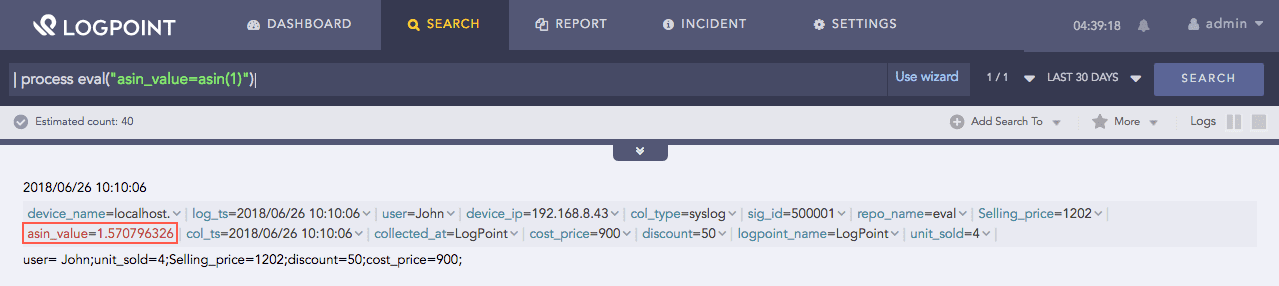
Asin function
This function accepts one argument X as input and returns the inverse hyperbolic sine of X.
Syntax:
| process eval("identifier=asinh(X)")
Example:
| process eval("asinh_value=asinh(1)")
The above example returns the inverse hyperbolic sine of 1 in the asinh_value identifier.
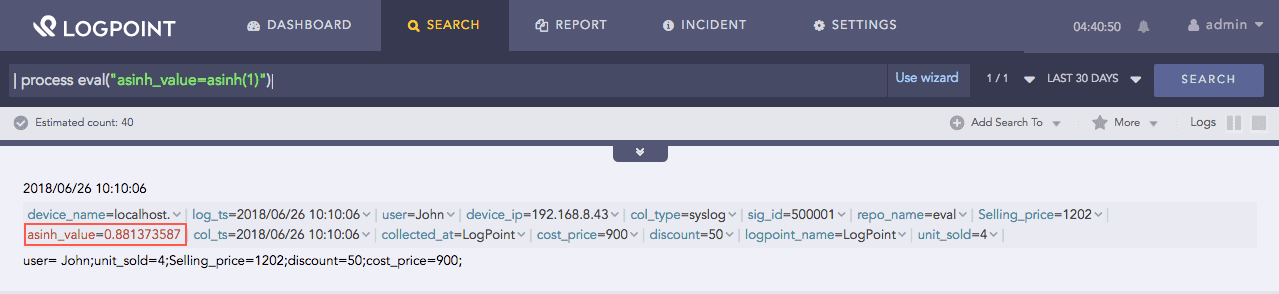
Asinh function
This function accepts one argument X as input and returns the cosine of X.
Syntax:
| process eval("identifier=cos(X)")
Example:
| process eval("cos_value=cos(length)") | fields length, cos_value
The above example returns the cosine of the length field in the cos_value identifier.
The fields command displays the value of length and cos_value in a tabular form.

Cos function
This function accepts one argument X as input and returns the hyperbolic cosine of X.
Syntax:
| process eval("identifier=cosh(X)")
Example:
| process eval("cosh_value=cosh(length)") | fields length, cosh_value
The above example returns the hyperbolic cosine of the length field in the cosh_value identifier.
The fields command displays the value of length and cosh_value in a tabular form.

Cosh function
This function accepts one argument X as input and returns the inverse cosine of X. X must be in the range from -1 to 1 inclusive.
Syntax:
| process eval("identifier=acos(X)")
Example:
| process eval("acos_value=acos(0)")
The above example returns the inverse cosine of 0 in the acos_value identifier.
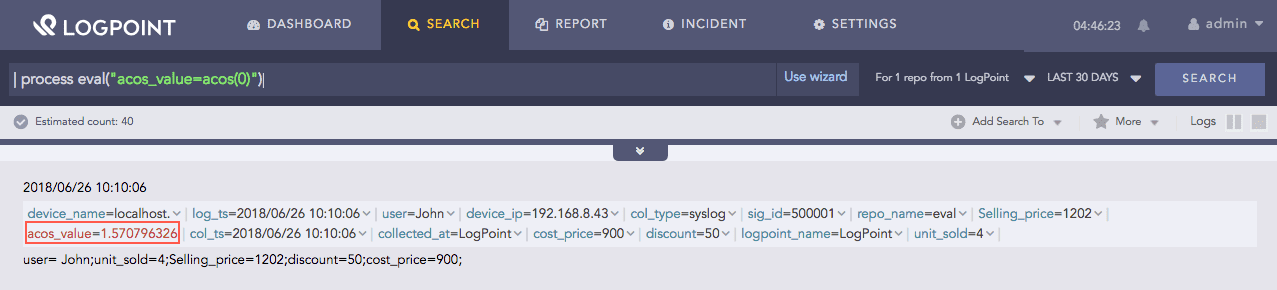
Acos function
This function accepts one argument X as input and returns the inverse hyperbolic cosine of X.
Syntax:
| process eval("identifier=acosh(X)")
Example:
| process eval("acosh_value=acosh(1)")
The above example returns the inverse hyperbolic cosine of 1 in the acosh_value identifier.
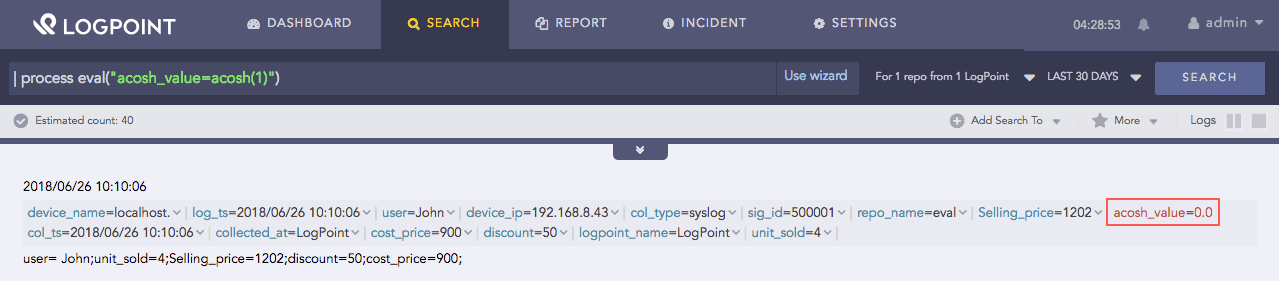
Acosh function
This function accepts one argument X as input and returns the tangent of X.
Syntax:
| process eval("identifier=tan(X)")
Example:
| process eval("tan_value=tan(length)")
| fields length, tan_value
The above example returns the tangent of the length field in the tan_value identifier.
The fields command displays the value of length and tan_value in a tabular form.

Tan function
This function accepts one argument X as input and returns the hyperbolic tangent of X.
Syntax:
| process eval("identifier=tanh(X)")
Example:
| process eval("tanh_value=tanh(length)")
| fields length, tanh_value
The above example returns the hyperbolic tangent of the length field in the tanh_value identifier.
The fields command displays the value of length and tanh_value in a tabular form.

Tanh function
This function accepts one argument X as input and returns the inverse tangent of X.
Syntax:
| process eval("identifier=atan(X)")
Example:
| process eval("atan_value=atan(1)")
The above example returns the inverse tangent of 1 in the atan_value identifier.
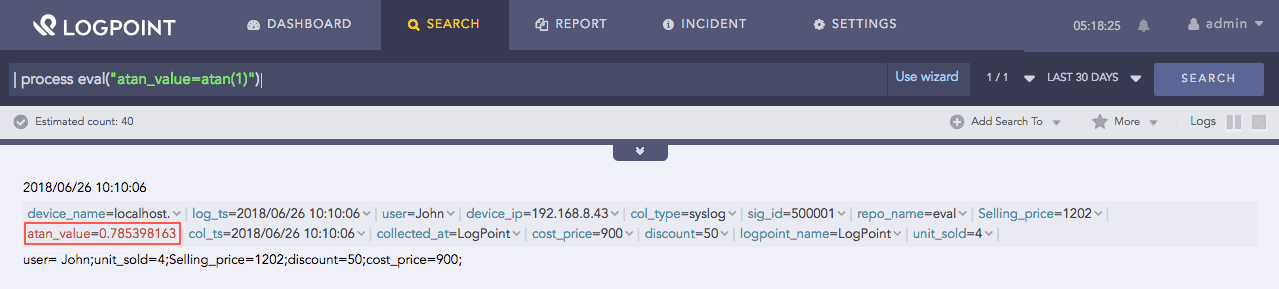
Atan function
This function accepts one argument X as input and returns the inverse hyperbolic tangent of X.
Syntax:
| process eval("identifier=atan(X)")
Example:
| process eval("atanh_value=atanh(1)")
The above example returns the inverse hyperbolic tangent of 1 in the atanh_value identifier.
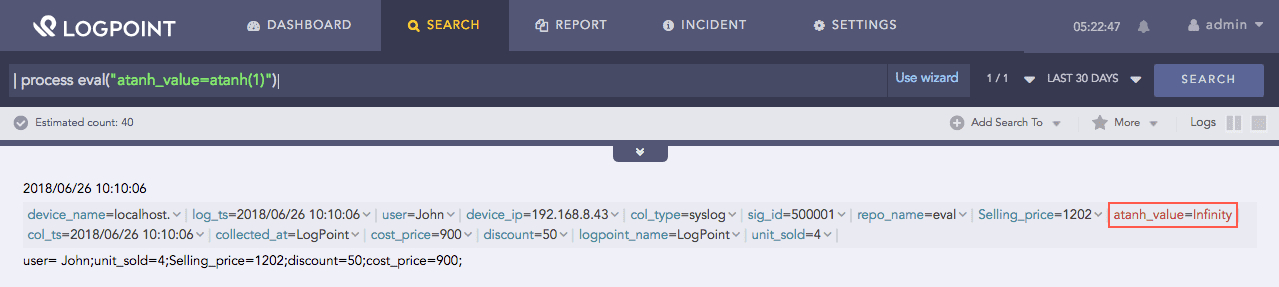
Atanh function
This function accepts two arguments X and Y as inputs and returns the hypotenuse of a right-angled triangle whose length and base are X and Y. It follows the equation of the Pythagorean theorem, (hypotenuse = sqrt{length^2 + base^2}).
Syntax:
| process eval("identifier=hypot(X,Y)")
Example:
| process eval("hyp=hypot(3,4)")
The above example calculates the value of the hypotenuse of the triangle whose length and base are 3 and 4 respectively and returns its value in the tan_value identifier.
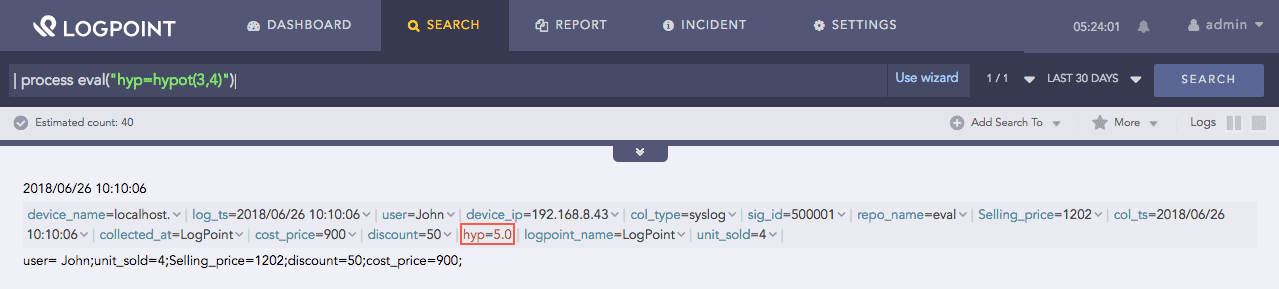
Hypot function